Urban pest control in Brazil faces an increasingly complex operating environment. With rising cases of mosquito-borne diseases in several states and stricter inspections in commercial and industrial areas, integrated pest management (IPM) now demands an unprecedented level of technical and documentary precision.
According to the Ministry of Health's 2026 epidemiological bulletins, states in the Southeast and Center-West recorded sharp increases in vector proliferation and confirmed cases of diseases such as chikungunya and dengue. This rise in synanthropic vectors directly affects the daily work of pest control operators, who face higher demand from commercial, industrial and food clients.
For insect and rodent control companies, the traditional model based only on chemical application and manual reports no longer meets today's legal and operational requirements.
Regulatory requirements and ANVISA RDC 622
Compliance with sanitary guidelines is no longer an administrative step. It is the core of the operation. ANVISA Resolution RDC 622 requires every urban vector and pest control service to be documented in a technical, standardized and traceable way, with proper service orders and proof of service.
Recent updates such as São Paulo's CVS Ordinance No. 3 of 2026 also reinforce mandatory integrated vector and pest control in industrial kitchens and food establishments, requiring strict physical, chemical and biological measures.
Companies still using manual processes or paper spreadsheets face serious bottlenecks:
- Field inefficiency: technicians spend time filling in paper forms instead of focusing on a detailed inspection.
- Audit risk: missing digital history or late nonconformity reports can lead to citations from health authorities or failed international quality audits (AIB, BRC, SQF).
- Lack of traceability: it is hard to prove visually that devices such as bait stations and light traps were monitored.
The move to digital field management
To stay profitable and compliant under this higher demand, managers need to modernize their processes:
- Real-time digital reports and service orders: instant records of device checks and of applications of ANVISA-registered products.
- Automated client data: portals where the end client can see capture history, device maps and certificates right after the service.
- Technical traceability: proof of service with geotagged photos and QR code scanning.
Modernizing the operation isn't only about saving hours on each route. It positions your company as a strategic, indispensable partner in meeting public health standards.
Record all of this and more with Rupipest
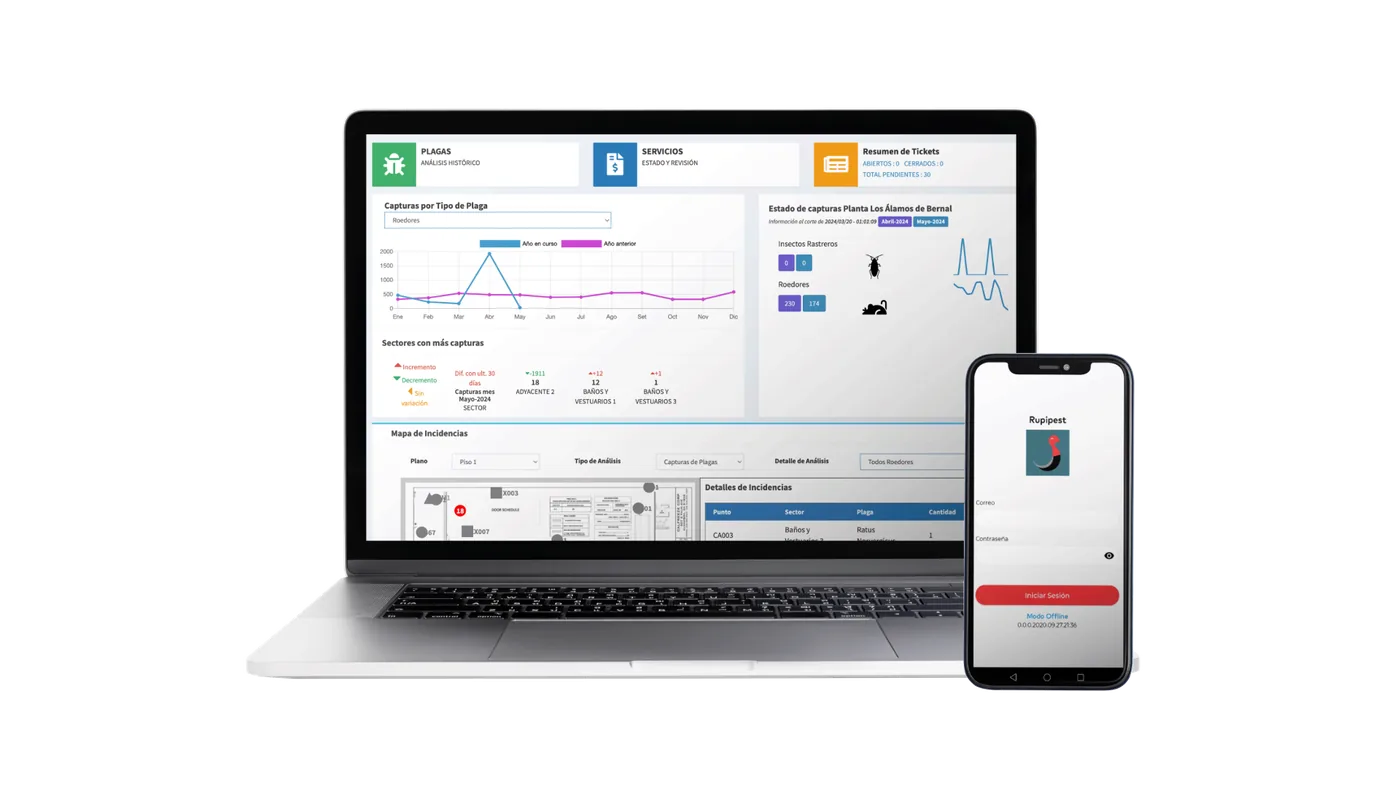
Monthly capture charts by pest type comparing this year with last year, a tolerance-threshold line that alerts you when infestation exceeds the acceptable level, capture status by category (crawling insects, rodents and flying insects) with last month's and this month's numbers, the sectors with the largest increase or decrease in the last 30 days, and a full summary of contracts with active inspection points. All updated automatically, without spreadsheets or paper, and available in real time.
If your operation needs to comply with RDC 622, CVS Ordinance No. 3 of 2026 and AIB, BRC and SQF audits, Rupipest was built for exactly that.